Hindu Wedding Invitation Wording: 40+ Examples
Copy-ready wording for every Hindu wedding ceremony: Haldi, Mehndi, Sangeet, Baraat, and reception. Formal, casual, and bilingual examples included.
Planning an event?
Invyt handles your RSVPs so you can focus on the celebration — not the spreadsheet.
Try Invyt free →Hindu wedding invitations do more work than most. They aren't just announcing a date. They're coordinating 5-7 separate events, managing guest lists that vary by ceremony, and often bridging two languages and two generations of family expectations in the same card.
This guide gives you ready-to-use wording for every ceremony, from the first family gathering to the final reception. Each section includes formal, casual, and bilingual-friendly versions. Take what works, adapt what doesn't.
The Hindu Wedding Ceremony (Vivah / Vidhi)
The main ceremony is where the formal tone matters most. Parents' names appear prominently in traditional invitations, a convention that holds across North Indian, South Indian, and diaspora weddings even when the couple is financing everything themselves.
Formal, traditional:
Shri [Father's Name] & Smt. [Mother's Name]
request the honor of your presence at the Vivah Ceremony of their son[Groom's Name]
with
[Bride's Name]
daughter of Shri [Father's Name] & Smt. [Mother's Name]
[Day], the [Date] of [Month], [Year]
[Time] onwards
[Venue Name], [City]Kindly RSVP by [Date]
Modern, couple-forward:
[Bride's Name] and [Groom's Name] are getting married.
Join us for our Vivah Ceremony | [Day], [Date] at [Time]
[Venue], [City]RSVP: [link or contact]
Warm family style:
With immense joy and gratitude, we invite you to witness and bless the sacred union of our children [Groom's Name] and [Bride's Name]. Your presence and blessings mean everything to our families.
Vivah Ceremony | [Date] | [Time] | [Venue]
One note on titles: "Shri" and "Smt." are standard for Hindu ceremony invitations. For British-Indian or North American diaspora families, many drop the titles entirely in the English version while keeping them in a Hindi insert card.
Haldi Ceremony Invitation Wording
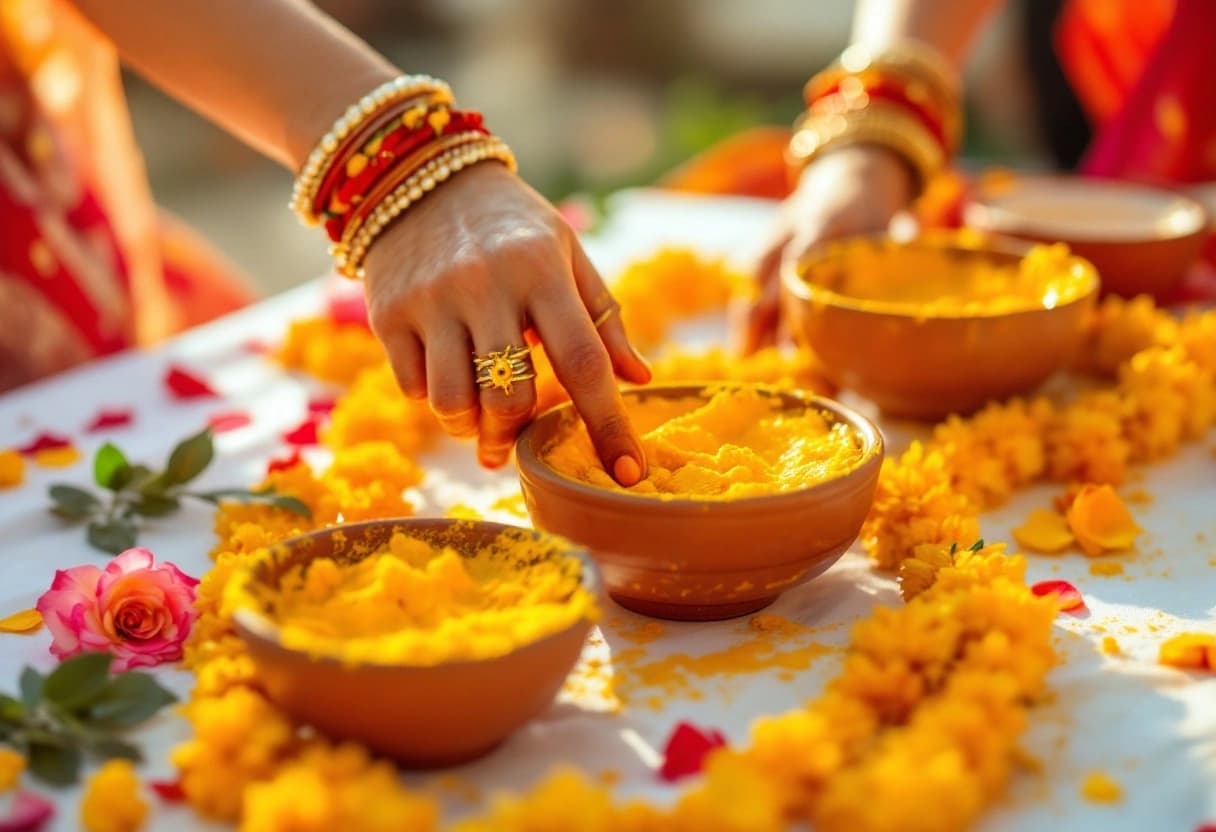
The Haldi is the most informal pre-wedding event, which means the invitation can (and should) match the energy. Close family and friends only, casual venue, everyone leaving yellow. The one thing that matters: warn guests about the turmeric.
A single line about clothing saves everyone considerable grief. "Wear clothes you love a little less" has become the accepted shorthand, and it works.
Playful and practical:
Time to turn golden.
Join us for [Bride/Groom]'s Haldi Ceremony | [Date] | [Time] | [Venue]
Come in yellow if you can, and definitely don't wear anything you'd like to keep clean.
RSVP to [contact] by [Date]
Warm, family-focused:
As [Name] prepares to begin this new chapter, we gather for the Haldi: a moment of love, laughter, and turmeric.
[Date] | [Time] | [Venue]
Yellow attire encouraged. RSVP requested.
Short and sweet:
Haldi for [Name]
[Date] | [Time] | [Venue]
Yellow clothes strongly recommended. Turmeric waits for no one.
RSVP by [Date]: [contact]
Bilingual (English/Hindi):
हल्दी समारोह में आपका स्वागत है
(Haldi Ceremony)[Date] | [Time] | [Venue]
Wear yellow or something you don't mind staining.
RSVP: [contact]
Mehndi Ceremony Invitation Wording
Mehndi typically happens the evening before the wedding, sometimes overlapping with the Sangeet. The invitation tone sits between the relaxed Haldi and the more formal reception: festive, warm, and celebratory without being stiff.
Classic:
The mehndi is set, the music is ready.
Join us as [Bride's Name] celebrates her Mehndi Ceremony
[Day], [Date] at [Time]
[Venue], [City]RSVP by [Date] to [contact]
Poetic:
As henna tells its stories, join us to celebrate the beginning of [Bride's Name]'s journey.
Mehndi Ceremony | [Date] | [Time] | [Venue]
Colorful attire welcomed. RSVP by [Date].
Modern, couple-hosted:
[Groom's Name] and [Bride's Name] invite you to the Mehndi Night
[Date] from [Time] at [Venue]
Henna, music, and good food.
RSVP: [link]
Bilingual:
मेहंदी की रात में आपको आमंत्रित किया जाता है
(Mehndi Night)[Date] | [Time] | [Venue]
RSVP: [contact]
For diaspora couples explaining the ceremony to non-Indian guests, a one-line description helps: "The Mehndi is a pre-wedding celebration where the bride receives intricate henna designs. Come celebrate, and maybe get some henna yourself."
Sangeet Invitation Wording
The Sangeet is the event everyone actually looks forward to. Music, dancing, family performances, and the kind of organized chaos that no wedding planner fully survives. The invitation should convey that energy without overselling it.
Celebratory:
The night before the big day, we dance.
Join us for the Sangeet celebrating [Bride's Name] & [Groom's Name]
[Day], [Date] | [Time] | [Venue]
Dress to move. RSVP by [Date]: [contact]
Formal but warm:
With music in our hearts, we joyfully invite you to the Sangeet Ceremony of [Bride's Name] and [Groom's Name].
An evening of song, dance, and celebration
[Date] | [Time] | [Venue]
Semi-formal / ethnic attire | RSVP by [Date]
Short, bold:
Sangeet Night
[Bride] x [Groom][Date] | [Time] | [Venue]
Come ready to dance. RSVP: [link]
For guests unfamiliar with the tradition:
A Sangeet is an evening of music and dance hosted by both families the night before the wedding. There will be performances, food, and dancing, and you're expected to participate.
[Date] | [Time] | [Venue]
RSVP by [Date]
Baraat Invitation Wording
The Baraat (the groom's wedding procession) isn't always a separate invite card, but for larger or destination weddings, it helps to set expectations. Guests joining the Baraat need to know arrival time, the starting point, and what to wear.
Practical and celebratory:
Join [Groom's Name]'s Baraat
[Day], [Date] at [Time]
Assembling at: [Location]
The procession departs at [Time] sharp.Come in your finest. We'll be dancing through the streets.
RSVP by [Date]: [contact]
Traditional format:
You are cordially invited to join the Baraat of [Groom's Name] as he makes his way to wed [Bride's Name].
Assembly: [Location] at [Time]
Traditional / formal Indian attire requested.
RSVP: [contact]
Reception Invitation Wording
The reception often has the broadest guest list: coworkers, neighbors, extended acquaintances who weren't at the ceremony. The tone can be slightly more universal, less ceremonially specific.
Classic:
[Family Name] & [Family Name] request the pleasure of your company at the wedding reception of
[Bride's Name] and [Groom's Name]
[Day], [Date] at [Time]
[Venue Name], [Address]Dinner and dancing to follow | Black tie / Formal Indian attire
RSVP by [Date]: [contact]
Modern:
We're married. Now let's celebrate.
Join [Bride's Name] & [Groom's Name] for their wedding reception
[Date] | [Time] onwards | [Venue]
Dinner, drinks, and dancing | [Dress code]
RSVP: [link]
For international guests (destination wedding style):
[Bride] and [Groom] are celebrating in [City], and we'd love for you to be there.
Wedding Reception | [Date] | [Venue]
Please RSVP by [Date] so we can arrange for you.
[Link for travel and accommodation details]
Bilingual Invitations: What Actually Works
Most diaspora couples sending bilingual invitations (English + Hindi, English + Punjabi, English + Tamil, etc.) make the same structural choice: one language per card face, not sentence-by-sentence alternation. Key logistical lines (date, time, RSVP details) often appear twice in both languages for clarity.
A few practical notes:
The English version typically leads with the couple's names. The Hindi/regional version leads with the parents' names. Both are correct. Neither version should be a literal translation — they serve different readers with different expectations.
For WhatsApp invitations (the dominant sharing method for Indian diaspora families), the full invitation text usually gets reformatted as clean plain text with the digital RSVP link at the bottom. Long formatted messages with line breaks and Unicode characters don't always render correctly across devices, so test on Android and iOS before sending. More on sharing Indian wedding invitations via WhatsApp in this guide to digital invitations on WhatsApp.
Managing Multiple Guest Lists for Multiple Events
The harder problem behind Hindu wedding invitations isn't wording. It's logistics. Different events have different guest lists. Your Haldi is close family only, your Sangeet includes extended family and friends, your reception is everyone including your parents' professional network. That's three separate headcounts, three separate dietary counts, three separate venues.
A spreadsheet works until it doesn't. The version-control problem (who updated which tab, which copy has the final RSVPs) gets bad fast when both families are contributing names.
The Indian wedding planning checklist covers the full timeline across ceremonies. For RSVP tracking specifically, Invyt's Indian wedding RSVP hub lets you create a separate event for each ceremony with its own guest list and RSVP link, so the Haldi link goes only to close family, the Sangeet link goes to the broader list, and you can see at a glance who's confirmed for what without merging spreadsheets or counting replies across group chats.
The multi-event setup is free, and you can share each event's link via WhatsApp, which is how most Indian family communication works anyway.

If you're coordinating 200+ guests across five events, the guest list management guide covers how to structure tracking before responses start coming in.
A Note on Design and Fonts
Invitation wording exists inside a design context. Traditional Hindu wedding invitations lean heavily on red and gold, with decorative borders and religious motifs (Om symbol, Ganesh imagery, lotus flowers). Modern invitations have moved toward terracotta, mauve, and sage with minimalist typography.
Whatever direction you choose, keep the logistical information visually distinct from the decorative text. Date, time, venue, and RSVP should be immediately scannable. Guests should be able to get that information with a three-second look. Beautiful invitations that bury the RSVP deadline in ornate script are beautiful problems.
For digital invitations, the online wedding RSVP guide covers how to structure your event page so guests can confirm attendance with one click. No email required, no form to fill out, no phone calls chasing late responses.
Frequently Asked Questions
What should be included in a Hindu wedding invitation?
A Hindu wedding invitation typically includes the bride and groom's names, their parents' names, the ceremony name (Vivah Ceremony or Vidhi), date, time, venue, and RSVP details. For multi-event weddings, a separate card for each ceremony is standard. Religious symbols like Ganesh or Om often appear at the top.
How do you write a Haldi ceremony invitation?
Include the ceremony name, date, time, venue, and a practical note about wearing old or yellow clothing. Turmeric stains permanently, and guests appreciate the warning. A line like "wear what you don't mind losing to turmeric" covers it. The tone can be playful; the Haldi is the most informal event on the calendar.
What is the wording for a Sangeet invitation?
Sangeet invitations focus on music, dance, and celebration. A clear format: "Join us for an evening of music and dance to celebrate the union of [Bride] and [Groom]. Sangeet ceremony on [Date] at [Time], [Venue]. RSVP by [Date]." Including a dress code line (semi-formal, ethnic attire) saves guests from texting to ask.
Can I send Hindu wedding invitations digitally?
Yes, and it's increasingly common, particularly for diaspora couples with guests spread across multiple countries. Digital invitations sent via WhatsApp or email work especially well for multi-event Hindu weddings since each ceremony can have its own RSVP link and separate guest list, replacing five different paper insert cards with five clean links.
How far in advance should you send Hindu wedding invitations?
For the main ceremony and reception, 6-8 weeks in advance is standard. Pre-wedding events (Mehndi, Sangeet, Haldi) are typically sent 4-6 weeks out. For destination or international weddings where guests need to book flights and accommodation, 3-4 months ahead is the safer window. Save-the-dates should go out even earlier.