Invyt.App Team
July 10, 2026
7 min read
A step-by-step birthday party planning checklist covering timeline, budget, guest list, invitations, and day-of logistics for any age.

Planning an event?
Invyt handles your RSVPs so you can focus on the celebration — not the spreadsheet.
Try Invyt free →Planning a birthday party comes down to six things done in order: set a budget, pick a date and venue, choose a theme, send invitations, lock the headcount, and handle day-of logistics. Skip the order and you end up booking a venue that doesn't fit your guest list, or ordering a cake for 30 when only 18 confirmed. The checklist below walks through each stage with the decisions that actually matter, plus the timing that keeps you from scrambling the week before.
Every other decision, venue size, catering style, decorations, flows from the budget. Decide the number first, then work backward.
For reference, a home-hosted party for 15-20 people usually runs $150-400 covering decorations, food, and a cake. Add a rented venue, a hired entertainer, or full catering and a mid-size party climbs to $500-1,500. Milestone adult birthdays (30th, 40th, 50th) with a venue rental and sit-down catering commonly land between $1,500 and $5,000, according to event planning industry averages.
A practical way to set your guest list ceiling: take your total budget, divide by a realistic per-guest cost ($15-40 depending on whether you're serving a full meal or just snacks and cake), and that's your maximum headcount. Decide this before you start inviting people, not after the RSVPs come in. For a full breakdown of what parties actually cost at different guest counts, see our birthday party budget guide.
Lock these together, since venue availability often decides the date more than the reverse.
Timeline guide:
Home parties skip the venue-booking step entirely, which is part of why they're the fastest option when you're planning on short notice. If you're renting a space, confirm capacity, parking, and whether outside catering is allowed before you commit, some venues restrict food vendors to an approved list.

Themes aren't required, but they simplify decisions downstream: decorations, invitation design, even the cake flavor conversation gets easier once there's a direction. For kids' parties, the theme usually drives the whole event. For adult milestone birthdays, "theme" often just means a color palette and a tone (formal dinner vs. backyard cookout vs. bar night with friends).
If you're stuck, work backward from the venue or season instead of picking a theme in a vacuum. A backyard party in July practically writes its own theme; a January birthday indoors has more open options.
An October birthday near the 31st is the extreme version of that logic, and a costume theme changes what the invitation has to say. Our Halloween party planning guide covers dress-code wording and why costume events need a longer RSVP runway than a regular party.
This is where most parties either run smoothly or turn into a headcount guessing game. Two decisions matter here: how you build the list, and how you send invitations.
Building the list: Separate "must invite" from "would be nice." For kids' parties, decide early whether it's a whole-class invite or a smaller friend group, and whether parents are expected to stay. That single decision changes your headcount math significantly since parents-staying doubles the effective guest count.
Sending invitations: Digital birthday invitations have mostly replaced paper for anything short of a very formal milestone event. A shareable link sent via WhatsApp or text arrives instantly, costs nothing, and lets you track responses on one dashboard instead of piecing together yeses from three different group chats. Paper still earns its place for milestone 40th, 50th, and 60th birthdays, where a physical invitation signals the occasion's formality, but even then a QR code linking to a digital RSVP page covers the actual response tracking.
Whatever format you choose, the wording matters more than people expect. If you want ready-to-copy options by age and tone, 40 birthday invitation wording examples covers kids, teens, adults, and surprise parties.
For age-specific planning, three guides cover the details this checklist doesn't:
Set an RSVP deadline 1-2 weeks before the party, not the week of. This gives you enough runway to finalize catering counts, seating, or party favor quantities without ordering blind or scrambling on Thursday for a Saturday party.
The single biggest headcount problem in birthday planning isn't people declining, it's people never responding at all. A dedicated invitation link that shows accepted, declined, and pending in one place lets you send a single reminder to just the pending group instead of texting each person individually or re-posting in a group chat the honoree might see (a real risk for surprise parties).
A specific workflow that works: send the invitation 3-4 weeks out with the RSVP deadline stated up front, check the dashboard weekly, and send one reminder nudge to pending guests exactly 3 days before the deadline. Waiting until the deadline itself to chase stragglers means you're finalizing catering the night before instead of with a comfortable buffer.
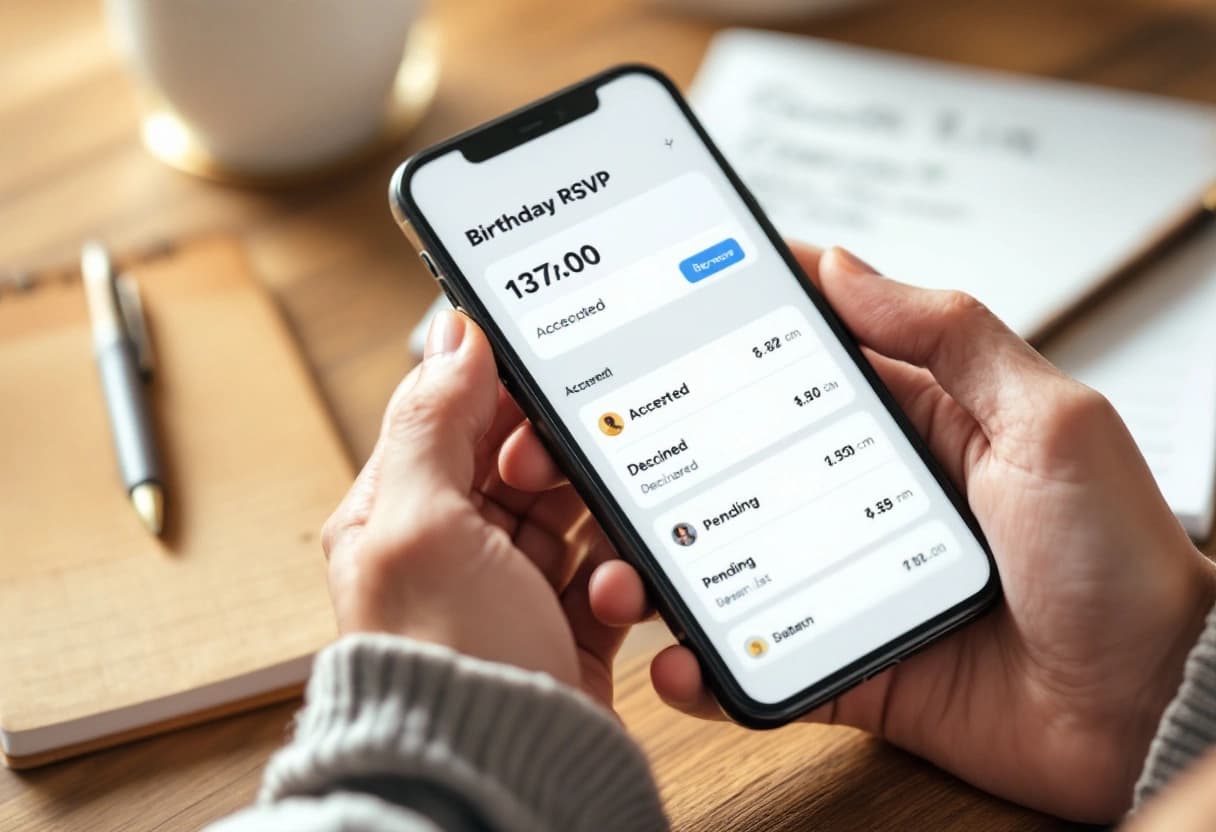
With the headcount locked, the remaining tasks are mechanical, but they're the ones people forget under time pressure:
Confirm final counts with your caterer or grocery order 48 hours out, factoring in any last-minute RSVP changes. Print or screenshot your guest list with dietary notes if you collected them (a surprisingly common gap: someone confirms attendance, mentions a nut allergy in a side text, and it never makes it to whoever's cooking). Assign one person, not yourself, to handle door greeting and coat/bag storage if it's a larger gathering, so the host isn't stuck at the entrance for the first 30 minutes. Set a rough timeline for cake, gifts, and any planned activities so the party doesn't drift without structure, especially for kids' parties where unstructured time turns chaotic fast.
Ready to send your invitations? Create a free birthday event page on Invyt, add your guest list, and watch RSVPs land on one dashboard instead of scattered across text threads.
Start 6-8 weeks out for a party of 20+ guests, or 3-4 weeks for a small gathering under 15 people. Popular venues and vendors book up 2-3 months ahead in peak seasons like spring and early summer, so lock the date and venue first.
A home-hosted party for 15-20 guests typically runs $150-400 in the US, covering decorations, food, and a cake. Venue rentals, entertainers, or catering push a mid-size party to $500-1,500. Milestone adult birthdays with a rented venue and full catering often land between $1,500 and $5,000.
There's no universal number, but venue capacity and budget per head usually decide it before preference does. A good rule: calculate your total budget divided by a realistic per-guest cost ($15-40 depending on catering), and let that number set the guest list ceiling before you start inviting people.
Digital invitations work for almost every birthday party today. They're free, arrive instantly, and let you track RSVPs automatically instead of guessing headcount from a group chat. Paper invitations make sense for milestone birthdays (40th, 50th, 60th+) where a formal keepsake fits the tone.
Set a clear RSVP deadline in the invitation itself, ideally 1-2 weeks before the party, and use a tool that shows you who hasn't responded so you can send a single reminder instead of chasing people individually. Group chats bury RSVPs; a dedicated invitation link with a response deadline gets faster answers.
Digital birthday invitations let you send in seconds and track RSVPs automatically, no group chat guessing required. Here's how to set one up for any age, free.
Milestone birthdays deserve more than a generic party. Here's how to plan a 30th, 40th, 50th, or 60th that actually fits the person turning it, decade by decade.
A home party for 15 guests can run $200. The same party for 100 guests can hit $4,000. Here's exactly where the money goes at each guest-count tier, with real cost tables.
Join thousands of event organizers who trust Invyt for seamless guest list management
Get Started Free